
Updated August 19, 2026
In 1939, Officer R. H. Galbraith of the California Highway Patrol mounted a motion picture camera on the dashboard of his patrol car, so he could take photos of the vehicles he followed. These photos helped provide evidence in court for the tickets he issued. This was a novel concept at the time.
Since Galbraith’s innovative use of cameras over 80 years ago, safety cameras have become commonplace. They are now critical for law enforcement and important for any industry that relies on fleets and transportation for daily work, such as construction.
What are Dash Cameras for Fleet Vehicles?
Fleet dash cams are vehicle-mounted camera systems that record road and driver activity to improve safety, reduce liability, and provide evidence in accidents. There are many uses of fleet safety cameras in commercial and construction vehicles, including:
- Promoting driver awareness of unsafe or distracted driving behaviors
- Reducing the number of safety-related incidents
- Evidence of circumstances and environment in the case of motor vehicle accidents
- In-cab audio alerts that stop unsafe actions immediately
- Real-time hazard detection and driver coaching
But like most technology, the question of dash cam benefits versus costs is a significant concern. Fortunately, safety cameras have a remarkable record of saving not just lives, but also money for fleet owners, in addition to reducing risk and exposure.
Key Benefits of Fleet Dash Cams
- Reduced collisions and safety incidents: Tenna’s data shows a 29% reduction in collisions with dash cam-supported safety programs
- Lower insurance claims: Customers have seen a 36% reduction in claims, resulting in massive savings
- Driver coaching and performance improvement: Driver safety scores increase by 20 points in just 30 days
- Liability protection: Clear video evidence helps exonerate drivers and speed up claim resolution
- Compliance support: Improve CSA BASIC scores and maintain ELD compliance
- Maintenance and fuel savings: Coaching on driving behavior can save $0.36 to $1.44 per gallon
Read on to see the full breakdown of dash cam benefits and savings for construction fleet vehicles.
Why Do Construction Companies Need Dash Cameras for Fleet Vehicles?
Fleet dash cameras keep drivers safe. They also protect construction businesses and drivers from liability and risk. Improving safety and avoiding risk are both equally important for construction companies that want to save money and lives.
For construction businesses, dash cameras for fleet vehicles can do much more than just record driving events, especially when connected to a GPS tracking system.
Contractors using Tenna can derive an extraordinary amount of data from vehicles and equipment, including:
- Real time locations
- Hours of use
- After hours movement
- Maintenance needs
- Driving behavior
- Fuel use
- Integrated video and telematics data
The beauty of dash cameras, especially with dual camera angles like the TennaCAM 2.0, is the clarity footage can bring to situations. They act as the missing piece that completes the puzzle.
Does fuel use increase because vehicles idle, or does it increase because of longer travel times on usual routes? Was a harsh braking alert the result of careless driving or avoiding a collision because of outside factors?
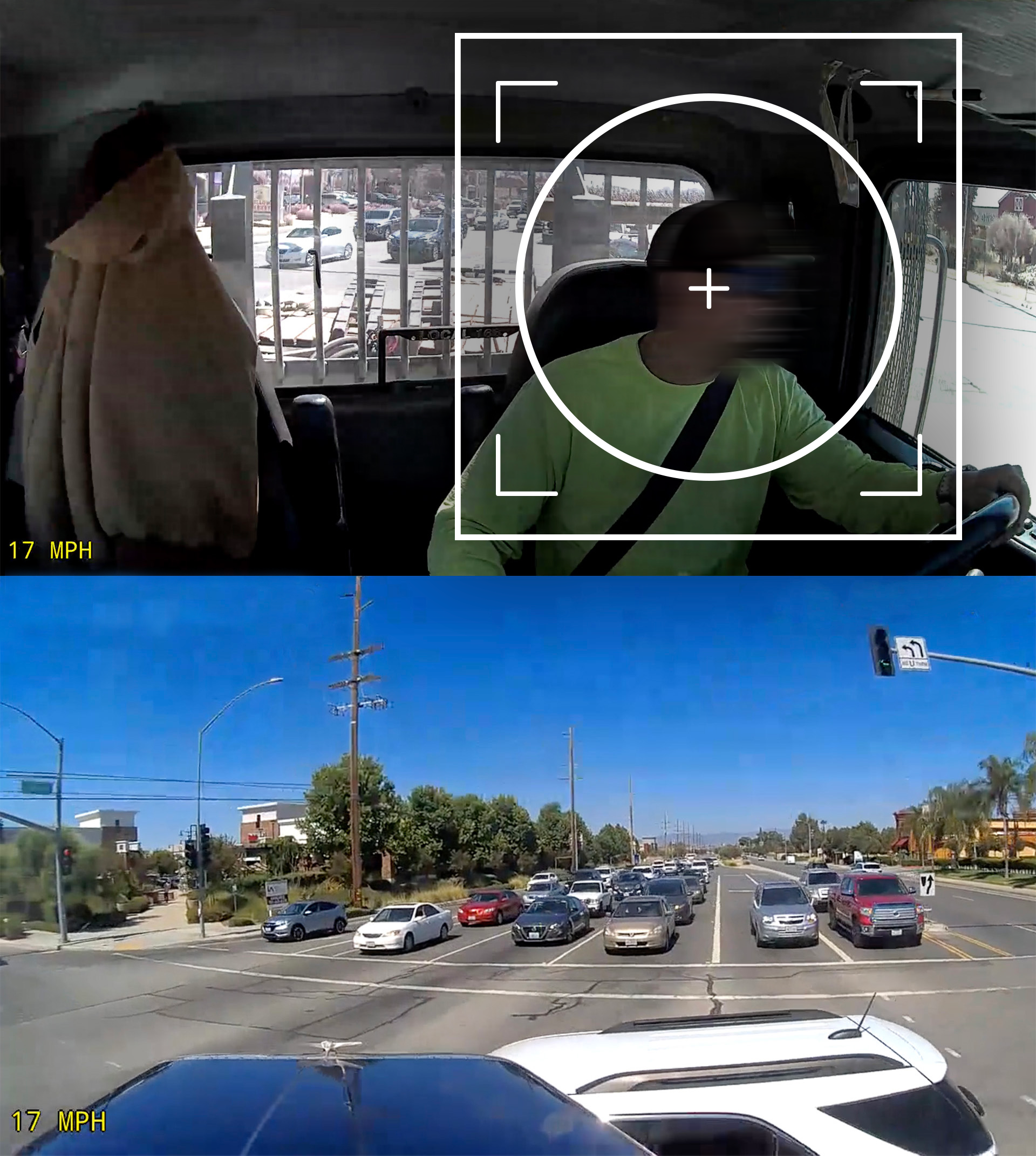
Plus, when using AI in construction safety, fleet dash cams can check driver behavior and seatbelt use, and analyze phone use, eyes off the road, and other distractions. The system can then create alerts for the driver, either on the screen or audibly.
Dash cameras aren’t just a “nice to have” addition to your fleet management solution anymore. They provide valuable context to a day’s worth of fleet data that helps solve huge risks for construction companies. Here are some examples of how.
How AI Dash Cams Reduce On-Road Incidents
In 2023, 6,138,359 motor vehicle accidents were reported to the police in the United States. Of these accidents, 40,901 included fatalities.
- 30% involved a drunk driver.
- ~49% were not wearing a seatbelt.
- Speeding contributed to 29%.
- 8% were because of driver distraction.
Plus, every year, approximately 6,400 people die because of drowsy driving. These stats show how important fleet dash cams are, especially for construction safety management programs and other commercial vehicle fleets. As previously mentioned, they help warn drivers about distractions and drowsy driving. They also alert drivers to external dangers like tailgating, headway issues, and forward collisions.
AI dash cams alert drivers right away about possible dangers or unsafe driving—which helps with accident prevention. These cameras can also alert safety or fleet managers when an incident happens by sending snapshots triggered by the incident.
Research on video-based safety monitoring has found that cameras are most effective when paired with driver feedback and coaching. Rather than simply recording what happened, these tools give safety teams visibility into risky driving behaviors, as well as a way to address them. That helps drivers correct issues and build safer habits over time.
That said, the evidence still shows that safety cameras lead to fewer accidents, even if no further safety training occurs. For example, the Insurance Institute for Highway Safety reports that rear cameras reduce crashes by 17%. A simple measure that can lead to a lot of savings.
The True Cost of Fleet Accidents
Even a single accident can have a devastating financial impact on a company. The National Safety Council reports that in 2024, the cost for each injury needing medical help was $48,000. The cost for each death was $1,540,000.
Researchers estimated total motor-vehicle injury costs at $559.3 billion (about $1,645 per person in the US). This includes wages and productivity losses, medical expenses, administrative expenses, motor vehicle property damages, and employer costs.
Tenna’s data shows a 29% drop in collisions with use of safety cameras in vehicles, including a reduction in cell phone use of 70% and dangerous driving habits by 75%.
Dash Cam Footage Improves Driver Safety Scores
Most safety programs for construction companies cover the basics: seat belt use, proper speed, gentle braking and awareness, but procedures alone are not enough to ensure compliance and manage corrective actions.
When safety managers can see footage from fleet dash cams, they can focus their training on the most common safety issues they are discovering about their drivers.
They can also use that footage to help fleet managers find solutions to previously unknown safety issues. If employees frequently use their phones for delivery directions, the company may choose to invest in dashboard systems to keep drivers’ eyes on the road.
Driver Safety Scores and Scorecards
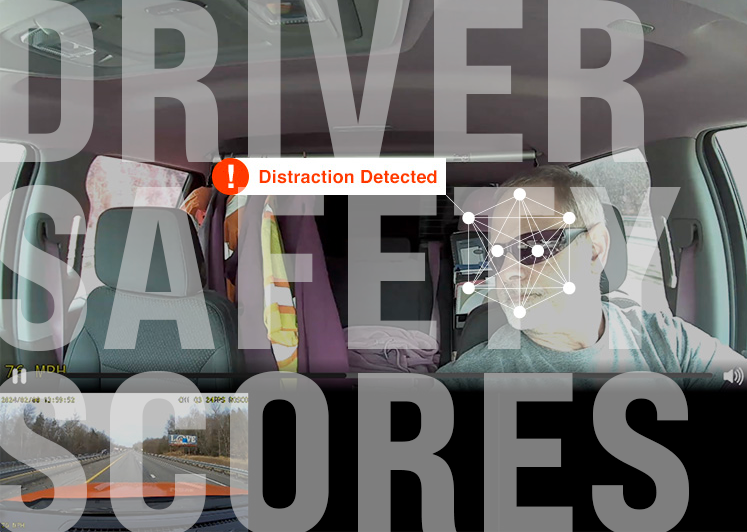
Anyone who manages a modern fleet knows about driver safety scores. These scores come from data like harsh braking and speeding events. Video footage from fleet dash cams shows what happened in these situations, which helps managers fix and improve these issues.
Internal data from Tenna users backs up research showing safety improvements after the installation of cameras. Driver safety scores have proven to go up by 20 points in just 30 days. Drivers also have reportedly three fewer safety events each day, including speeding and harsh braking.
In a fleet of 50 vehicles, a ten-point improvement in driver safety scores leads to one fewer time-loss incident each month. Having data on your side can help you build your safety program, determine training needs, and even determine which drivers you hope to promote.
Dash Cams Provide Video Evidence for Swift Litigation
When an employee has a work-related accident, costs can add quickly. These costs include medical bills, legal fees and repair expenses. Lost productivity also adds to the total cost. This affects both the injured employee and the managers who handle the paperwork after the accident.
Out-of-pocket expenses below your deductible can cost you a lot. Managing and fixing small issues can add hundreds of thousands of dollars.
By eliminating one small claim of $5,000, contractors can pay for a fleet camera system in that vehicle for 10 years. And avoiding larger claims can save millions of dollars for the whole organization.
Construction fleet dash cam systems can reduce some of that time loss and liability. Instead of waiting for police to gather evidence and finish accident reconstruction, recorded footage helps fleet managers quickly share clear proof of what undeniably happened with police and insurance.
If the footage shows an employee was at fault, the company can quickly resolve the issue. This helps with insurance and the injured party, and it avoids drawn out time and extra legal costs. If the footage shows the employee was not at fault, there is clear proof. This can help avoid or speed up claims, saving time and money.
Real-World Results: Exoneration and Claims Reduction
Ferreira Coastal Construction, a Tenna user, utilizes fleet dash cams in their vehicles and these cameras have helped exonerate their drivers. The contractor said, “Cameras have been able to save us where the other person goes back to their carrier and says it was Ferreira’s fault. Then we watch the footage, and it’s clearly not Ferreira’s fault. We send that to the carrier, and they just send us the check.”
With Tenna fleet dash cams, customers have seen a 26% reduction in claims, resulting in massive savings—in money and time.
Anvil Builders, for example, saved roughly $100,000–150,000 on a single claim. “That pays for a lot of cameras,” said Matt Paves, Operations Consultant at Anvil. “It doesn’t have to happen often, whether its initial cost or monthly cost, everything is pennies compared to what you can save.”
Implementing Fleet Dash Cams Lowers Insurance Costs
The presence of cameras helps to improve driver safety scores, reduce accidents, clear drivers of blame, dismiss lawsuits and speed up settlement claims. All these factors can lower insurance costs.
Understanding CSA BASIC Scores
Safety camera footage can help in improving CSA BASIC scores. The Federal Motor Carrier Safety Administration (FMCSA) uses seven categories in its Compliance, Safety, and Accountability (CSA) program to categorize carriers for safety:
- Unsafe driving
- Crash indicator
- HOS compliance
- Vehicle maintenance
- Controlled substances/alcohol
- Hazardous materials compliance
- Driver fitness
Inspectors collect data from roadside inspections, crash reports, investigations and other violations over 12 months. The system ranks this data by category and uses it to create a company’s BASIC score. Insurance companies review BASIC scores as part of their overall fitness and risk evaluations.
Additionally, the FMCSA runs a program to evaluate if driver error has caused crashes on a company’s record. Submitting camera footage during the evaluation process is important so accidents (not caused by drivers) do not negatively affect the company’s BASIC score. This is another way to prevent higher insurance rates.
Dash Cams Can Offer Maintenance and Fuel Savings
The Department of Energy says that aggressive driving can hurt gas mileage. This includes speeding, quick acceleration and hard braking.
At highway speeds, it can lower gas mileage by about 15% to 30%. In stop-and-go traffic, it can drop by 10% to 40%.
Using safety cameras to coach drivers and check routes can save $0.36 to $1.44 per gallon (based on a cost of $3.60/gallon).
Video footage can also show how aggressive driving, like hard accelerating or braking, puts more stress on the vehicle. Driving at high speeds is hard on the transmission, while harsh braking is damaging to the brakes and tires, and hard turns can cause more rapid and uneven wear and strain the alignment, shocks and suspension.
If maintenance programs find problems beyond normal wear and tear, camera footage can help identify route causes. It can also identify drivers who need coaching and highlight routes with traffic that cause extra stops and starts.
Dash Cam Benefits Outweigh the Costs for Fleets
At the end of the day, what are dash cameras going to bring to your business? Yes, a cost exists to equip your fleet with cameras, including the price of the camera hardware and monthly data fees. But are the dash cam benefits to your business worth the price when you add up the savings these devices provide?
The answer is a resounding yes. Adding safety cameras to a telematics-based fleet management program is a great way to improve driver safety and add significant cost savings for your construction business.
Brandon Pensick, the senior vice president of Ferriera Coastal Construction, said, “One incident will cover the cost. You get your money back quickly with exonerating someone who had an accident.”
Additionally, being able to effectively launch incentive programs can boost employee morale while improving safety. In all cases, the benefits of dash cam for fleet vehicles outweigh the costs associated.